
Your community plans for parking. Mine plans for a car attack.
A kosher restaurant burned in Montreal two weeks after Canada's new hate crime law came into force.
Security video caught a man in a white T-shirt setting a fire on Décarie Boulevard at around 3:15 Saturday morning, then walking away. Nearly eighty firefighters worked for hours to bring it under control. It gutted Nöam, a kosher restaurant in Côte-des-Neiges, and badly damaged the business next door. Luckily, nobody was hurt. Montreal police handed the file to the arson squad and say they haven't established a motive.
They may never establish one. The absence of a determined motive isn't the absence of an effect.
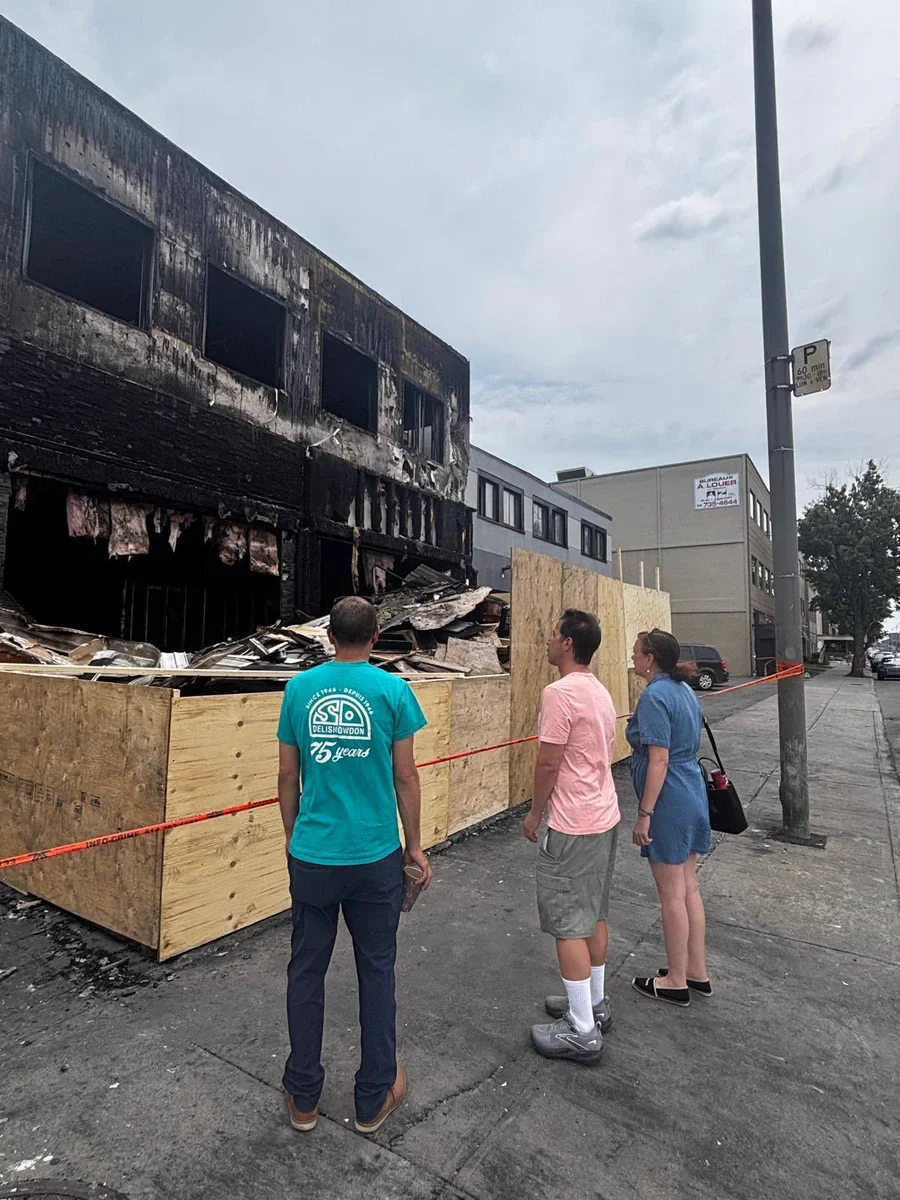
Community member look on at the ruins of Nöam, a kosher restaurant in Côte-des-Neiges.
(Source: MP Anthony Housefather on X)
Jewish families in Côte-des-Neiges woke Saturday to a burnt-out storefront with a kosher certificate in the window, in the neighbourhood where a gunman opened fire in June and killed a police officer and a 68-year-old Jewish man. Quebec's public safety minister ruled out terrorism. Radio-Canada confirmed the shooter had distributed an incel manifesto, and investigators examined whether he was firing at the offices of Pornhub's parent company across the street. So it wasn't an attack on Jews. It was still an afternoon every Jewish school and business in the area spent in lockdown assuming it was. Even if Saturday's fire turns out to be an insurance job, the calculation a family makes about where it's safe to eat has already changed, and it stays changed.
Six days earlier, two Toronto locations of Kiva's, a bagel bar that's been a fixture for Jewish Toronto since 1979, were hit within about twenty minutes of each other. One window took gunfire. The other was smashed. Police assigned it to the Hate Crime Unit and looked for the same dark SUV at both scenes. Nobody was inside either shop. What Toronto's police chief said last month about a run of shootings at synagogues and Jewish schools is the thing to hold onto: the method is criminals for hire. The person who fires at a bakery window under that model may hold no view about Jews whatsoever. He was paid. The hatred is upstream, in whoever hired him, and the only person a hate crime charge can reach is the contractor who showed up.
Statistics Canada released 2025 hate crime figures on July 22. Police recorded 4,708 hate crimes nationally, 1,115 of them motivated by religion. Of those, 788 targeted Jews, which is 70.7 per cent of the religion-motivated total and 16.7 per cent of every hate crime in the country. Jews were 0.9 per cent of the population at the last census. The next most targeted religious group was Muslim Canadians, at 204.
Those numbers are down from 943 in 2024. Someone will offer me that as good news.
“What a neighbourhood builds tells you what it expects, and Jewish community infrastructure in this country now gets planned around the possibility of attack. ”
B'nai Brith's count went the other way. Its audit collects reports directly from people rather than through police, and it logged 6,800 incidents in 2025, up 9.4 per cent and the highest since it began counting in 1982. Two ledgers, same year, opposite directions.
People stopped bothering. A StatsCan survey in 2019 found only about 29 per cent of hate crime incidents were ever reported to police, and nothing since has improved the incentive. Between 2022 and 2024, non-violent hate crimes cleared at 13.8 per cent against 30.6 per cent for other non-violent crime. Hate-motivated mischief, meaning the graffiti and the broken windows and the swastika on the door, cleared at 10.5 per cent. The RCMP logged 994 hate-motivated crimes between January 2025 and April of this year and cleared 13 per cent.
The decline wasn't Jewish-specific, and I won't pretend otherwise. Incidents motivated by sexual orientation fell 19 per cent and the overall total fell 3 per cent. Violent hate crimes clear at 47.1 per cent, close to the rate for violent crime generally. The system responds when a person gets hit and shrugs when a door gets painted. The graffitied door is where the volume is, and it's where a neighbourhood learns what it's worth.
The government noticed. The Combatting Hate Act received royal assent on June 18 and came into force July 18. It creates standalone hate crime offences instead of leaving hate motivation as something a judge weighs at sentencing, adds an offence for intimidating people entering a place of worship, and criminalizes displaying certain symbols to promote hatred. Before it, the main hate propaganda charges couldn't proceed without the Attorney General's consent, which is part of why prosecutions were rare and convictions rarer.

Shoppers coming to support Kiva's bakery in Midtown Toronto, after it was shot, July 26. 2026.
(Source: Canadian Jewish News Credit: L:ila Sarick)
A new offence on the books is the easy part, and this government has been better at announcing tools than using them. Ministers have spent two years condemning attacks on Jewish institutions in language nobody could fault while the clearance rate for hate-motivated mischief sat at one in ten. The Attorney General's consent requirement was a bottleneck for decades and it took until 2026 to move it. A law in force on July 18, a shooting on July 26 and a fire on August 1 is as clean a test as anyone could ask for. If the arson squad identifies the man on that video and no hate provision is ever attached to the file, the community will draw the obvious conclusion, the 2026 numbers will fall again, and someone will call it progress.
None of this stops at Ontario. Someone poured fuel on the doors of Schara Tzedeck in Vancouver and set them alight in 2024. Congregation Emanu-El in Victoria, standing at Blanshard and Pandora since 1863, was tagged with antisemitic graffiti last August, days before Tisha b'Av — the fast day mourning the destruction of both Temples in Jerusalem. The Jewish Federation of Greater Vancouver puts the share of Jewish British Columbians who've experienced at least one antisemitic incident since October 7 at 62 per cent.
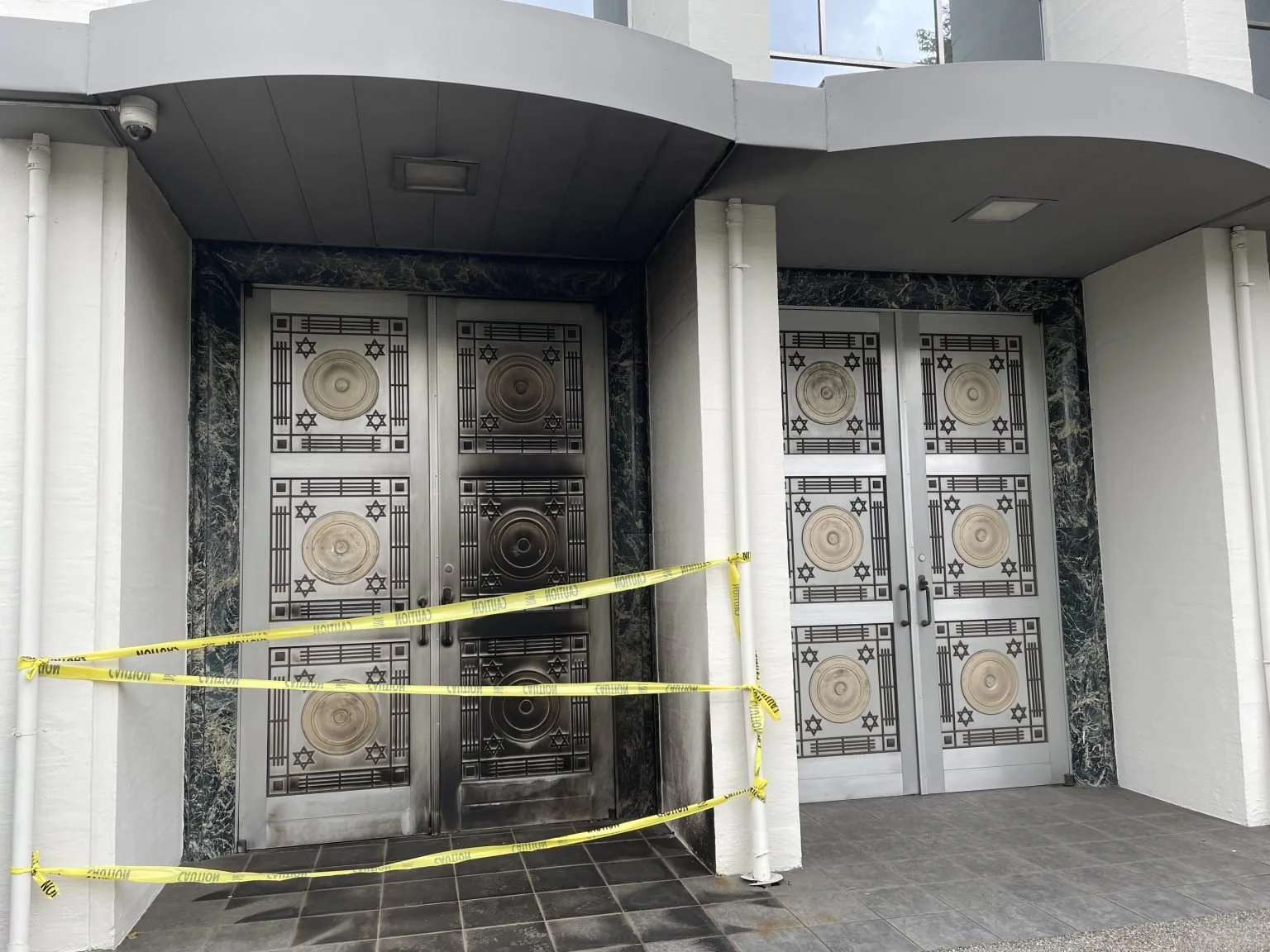
The blackened doors of the Schara Tzedeck Synagogue after the shul targeted by an arsonist.
(Source: Canadian Jewish News | Credit: Vita Kolodny)
I write about community infrastructure. What a neighbourhood builds tells you what it expects, and Jewish community infrastructure in this country now gets planned around the possibility of attack. The line items are specific. Bollards along the sidewalk in front of the sanctuary doors, so a vehicle can't be driven into the crowd leaving Shabbat services. Cameras covering the parking lot, the preschool entrance and the loading door. Laminated glass on the street-facing windows. A private security contract that runs year-round and doubles for the High Holidays, when the building is fullest and everyone knows it. A roster of congregants who volunteer to stand at the doors through Rosh Hashanah and Yom Kippur, watching the street while the rest of us pray. Ottawa covers part of this through the Canada Community Security Program, which carried $21.8 million in 2025-26 and drops to $16.8 million a year beginning in 2026-27. Most congregations and community centres in this country plan for accessibility, capacity and cost. Ours plans for those things, and then plans again for the possibility that someone will drive into the crowd on the steps or set the doors alight while there are people inside.
The defence offered for all of it is that this is about Israel. That defence requires the target to have something to do with Israel. Nöam was a restaurant on Décarie serving Mediterranean and Italian food to people in Côte-des-Neiges. Kiva's sells bagels at Yonge and St. Clair. Neither has a foreign policy. Neither does a synagogue door in Vancouver, a wall in Victoria, or the Hasidic men assaulted and robbed of their shtreimels walking home from Friday night services in Outremont on July 3. What the targets share is that they're Jewish. Anti-Zionism is Jew hatred, and I'm not interested in the version of this conversation where I soften that to be taken seriously by people who've never had to wonder whether their kid's school needs a security guard.
The law changed two weeks before that fire. Now we find out whether anyone intends to use it.