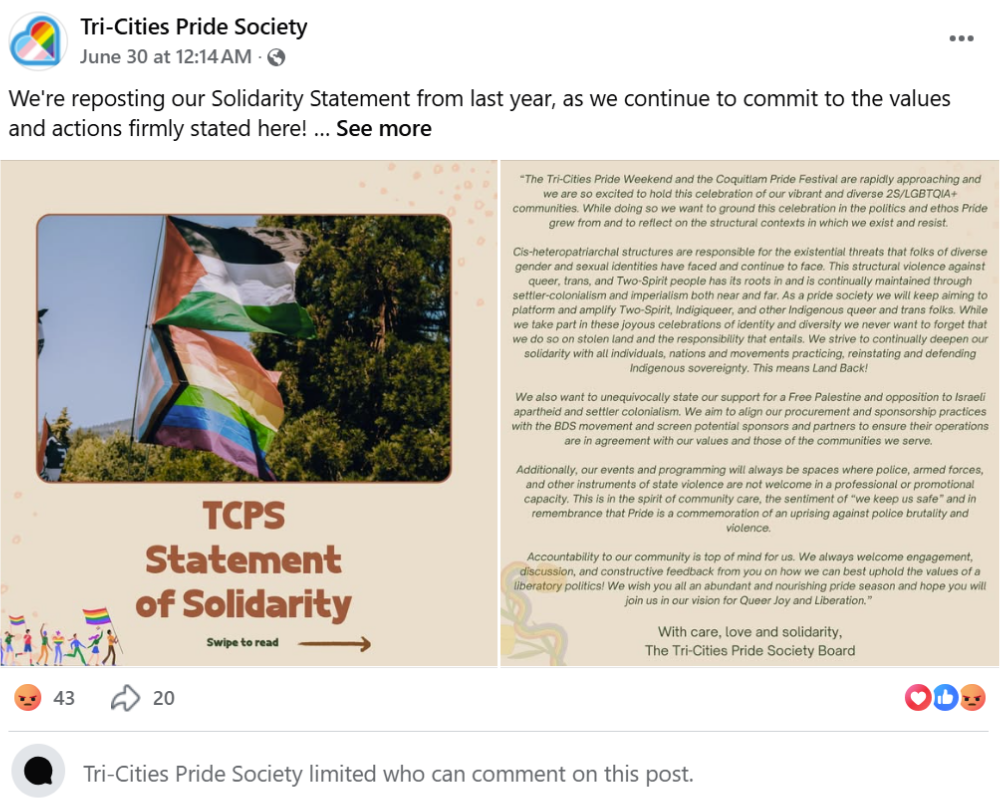
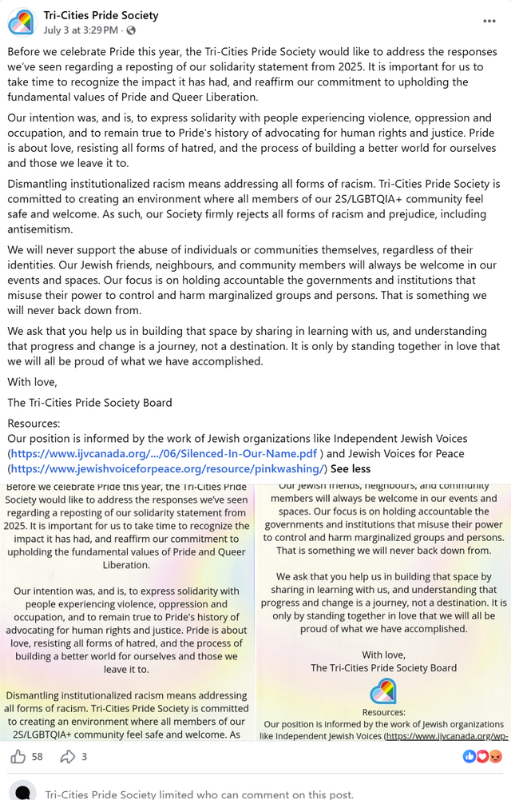
Pride is supposed to be for all of us. Two statements from the Tri-Cities Pride Society say otherwise.
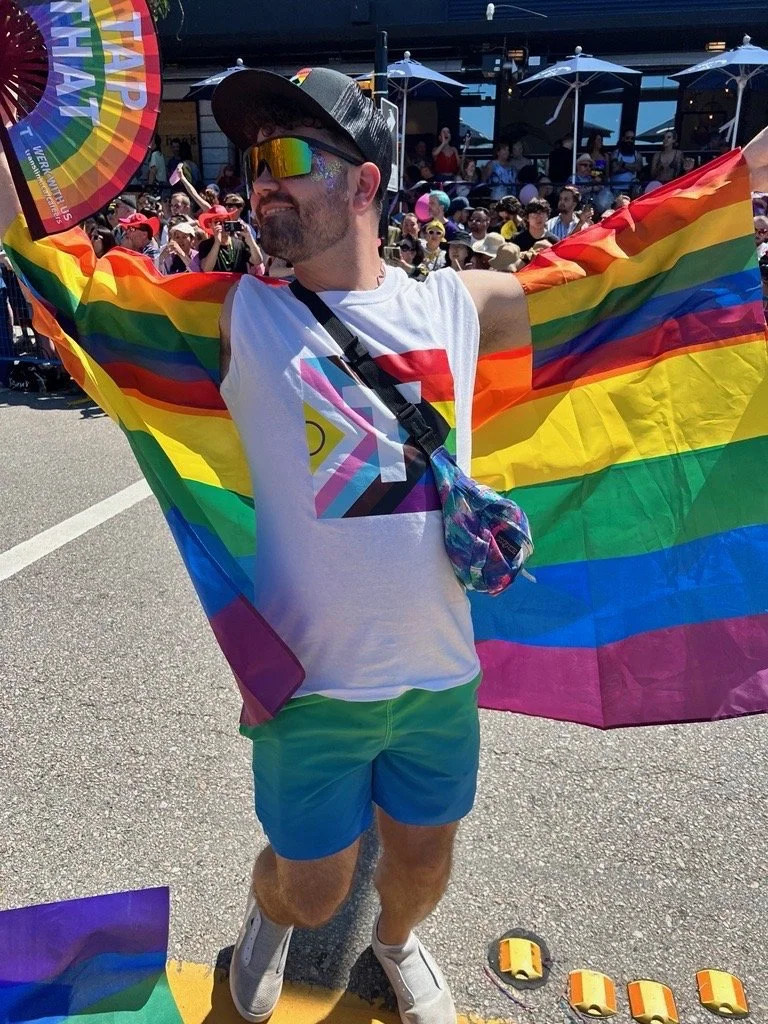
Me walking in the 2025 Vancouver Pride Parade. Antisemitic and anti-Zionist protestors interrupted the parade, ultimately cancelling it early.
The Tri-Cities Pride Society reposted its Solidarity Statement last week (scroll to the bottom for the screenshots), as it has made a tradition of doing. When people objected, the board issued a second statement: Jewish friends, neighbours, and community members will always be welcome, the Society firmly rejects antisemitism, and its focus is on holding accountable governments and institutions, not people. I want to take both statements seriously. I'm a queer Jewish resident of this region, I've spent my adult life in community work here, and Pride matters to me. That's why this is hard to write.
Why this is a policy of exclusion
The Solidarity Statement commits the Society to aligning its procurement and sponsorship with the Boycott, Divest, & Sanction (BDS) movement and screening sponsors and partners to make sure their operations agree with its values. Stated plainly: an organization can be excluded from Pride based on its relationship to Israel.
Here's what that means in practice for Jews. Connection to the land of Israel isn't a foreign policy position bolted onto Jewish identity. For most Jews, Israel is part of our identity itself, woven through our prayers, our calendar, our history, and our sense of peoplehood across thousands of years. You can hold a hundred different views on the Israeli government, its leadership, its conduct, and most Jews do, with fierce disagreement among ourselves. But a test that screens out anyone connected to Israel is a test the large majority of Jews fail by definition. That's not a screen on a policy. It's a screen on a people.
Don't take my word for the numbers. In 2024, a survey of Canadian Jews sponsored by three progressive Jewish organizations (the New Israel Fund of Canada, JSpaceCanada, and Canadian Friends of Peace Now, all sharp critics of the current Israeli government) found that 84 per cent of Canadian Jews feel emotionally attached to Israel, and 94 per cent support Israel's existence as a Jewish state. Ninety-four per cent. A screen built around a movement whose program rejects that position isn't screening out a fringe of my community. It's screening out nearly all of it. (Further research on Jews and Zionist identity here.)
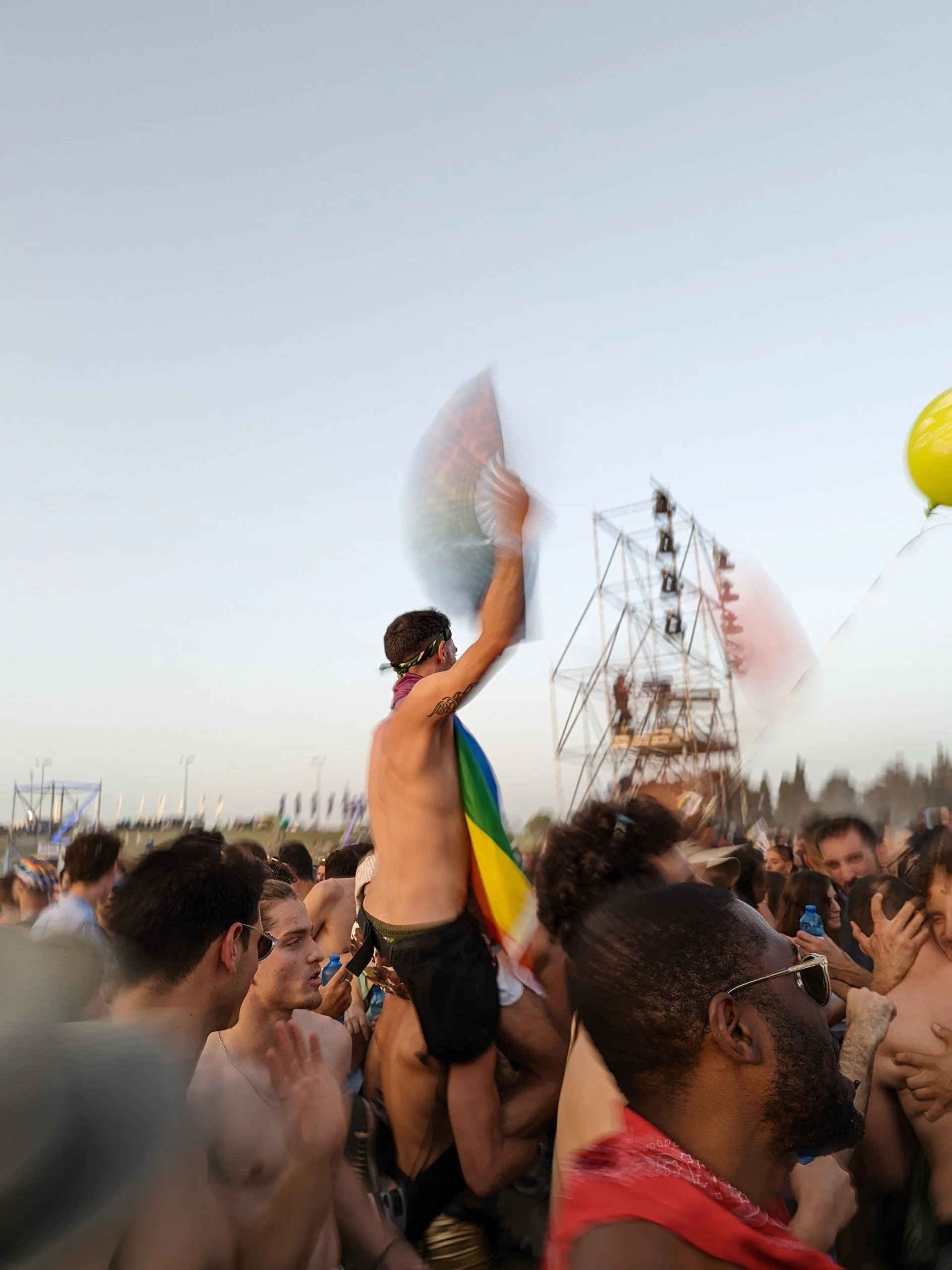
Tel Aviv Pride 2022
Judge it by the movement's own standard
Whether the board believes this is antisemitic doesn't settle anything, and I want to be clear about why. This is a Pride society. It operates by a principle it would state proudly: discrimination is measured by its impact, not by whether the people causing it meant well. Structural racism doesn't require a single conscious racist. That's the whole insight of the anti-racism this movement is built on. You don't get to point at your good intentions and call the harm cancelled.
So apply that standard here. A procurement screen that excludes organizations by their connection to the one Jewish state has a predictable impact: it lends the weight of a community institution to the idea that connection to Israel is a stain a person can be filtered for. That is the raw material of harassment, of Jews made to answer for a government they didn't elect, of Israelis treated as fair targets because of where they come from. The statement never has to say we don't want Jews here in order to build a Pride in which most Jews are unwelcome. Discrimination dressed as ethics is still discrimination.
The second statement changes nothing, which is the problem
I read the board's follow-up carefully and they say they oppose antisemitism and want to be welcoming. But look at what it actually does, though. It reaffirms the Solidarity Statement. It keeps the screen. It tells Jews we will always be welcome in the Society's events and spaces while preserving the policy that sorts our community's organizations by their distance from Israel. Welcoming the people while screening their community's institutions restates the original problem in warmer language. The welcome remains conditional; the condition just went unmentioned this time.
The follow-up says the Society's focus is on governments and institutions that misuse power, not on individuals. But a procurement policy in the Tri-Cities doesn't touch a government. It can't — the Israeli government isn’t providing procurable services. The only entities it will ever reach are here: local sponsors, local partners, the community organization or business whose ties to Israel put it on the wrong side of the filter. A screen aimed at a state ten thousand kilometres away lands, every time, on your neighbours.
Citing the exception to overrule the community
Then there's the part of the second statement I most need the board to sit with. As evidence that its position is informed by Jewish perspectives, the Society cites Independent Jewish Voices and Jewish Voice for Peace, the second of which is an American organization.
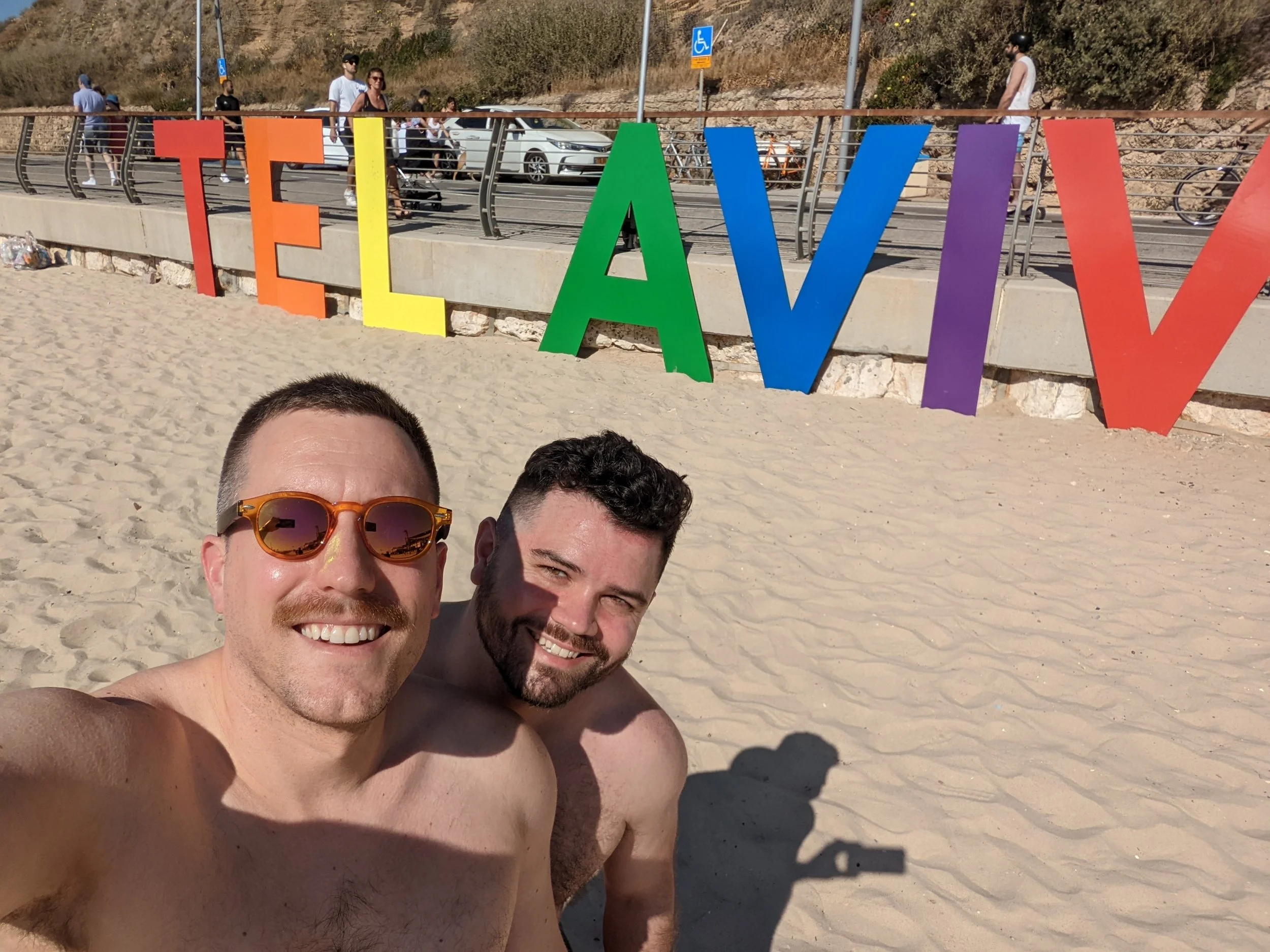
My husband and I on our honeymoon in Tel Aviv in 2022.
Notice this disingenuously defensive move: when the community you've hurt objects, you don't meet with that community. Instead, you locate the small minority that already agrees with you and present its agreement as consultation. Both groups sit within the sliver of Jews, roughly one in twenty (if we’re being generous), who don't share the community's near-universal support for Israel's existence, and both are estranged from the mainstream of Jewish communal life precisely because of it. Their endorsement tells you nothing about the community your policy affects. It tells you only that you searched until you found a yes.
The queer community has a name for this move when it's done to us. When a government defends an anti-LGBTQ law by pointing to the one queer organization that endorses it, nobody calls that listening. We call it tokenism, and we're right to. The second statement asks us to share in learning together. Learning would look like sitting down with the people who raised the concern: the local Jewish community, its congregations and institutions, the queer Jews the screen actually affects. Sourcing a stamp of approval from the one corner of the community guaranteed not to object is the opposite of learning. It's how you avoid it.
One standard, applied to one people
No other community walking into Pride is asked to do any of this. No one is screened for ties to any other nation, any other conflict, any other government.
Look at what that silence covers. In Iran, the state executes gay men. Uganda's 2023 law makes some homosexual acts punishable by death. Under the Taliban, queer Afghans are hunted. None of it produces a screen. None of it produces a statement. Out of every injustice on earth, one country was chosen for a procurement policy, and it happens to be the one attached to the world's only Jewish-majority state, and the only country in its region where a Pride parade can be held at all. When a single group is held to a standard applied to no one else, the word for that isn't solidarity. It's a double standard, and for Jews, the double standard is an old and familiar knock at the door.
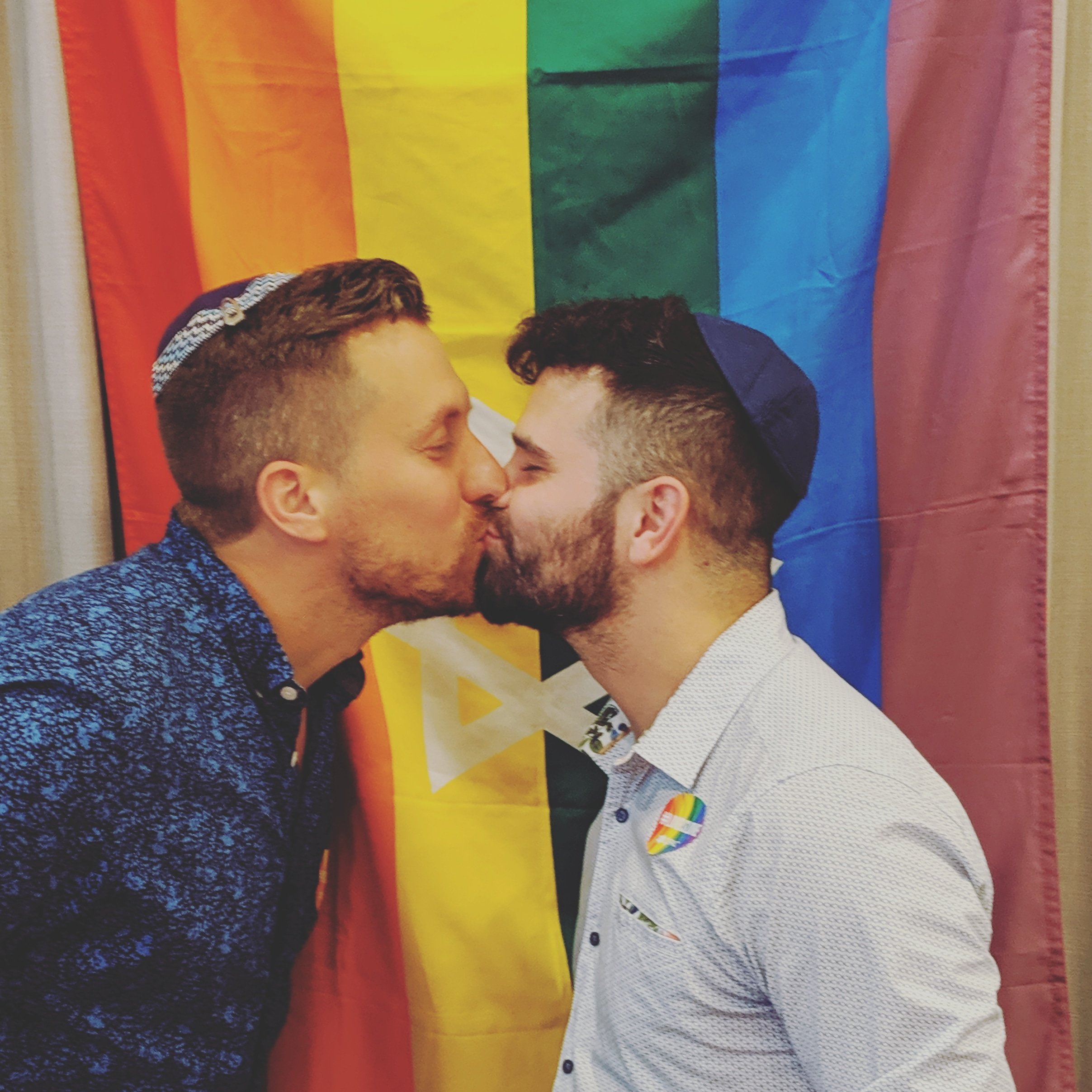
My now-husband and I stealing a smooch at the 2019 Shabbat Dinner with Pride Colours.
What Pride out here is actually for
Pride in the Tri-Cities isn't the Vancouver parade and festival. It's smaller and closer to home: neighbours, teachers, students in our local schools, the family down the street with a flag on the balcony. Its whole promise is that you don't have to commute to be yourself, that this community has room for all of who you are. For me that has always meant both halves at once, queer and Jewish, with no asterisk on either. I'm writing this because I want that promise kept, and because I believe most of the people who show up to this Pride want a movement whose mission is love, not a loyalty test administered at the gate.
What I'm asking for
I'm not asking the Society to adopt my politics on the Middle East. I hold Palestinian life and dignity as real and grievable, as most Jews I know do, and I'll defend anyone's right to criticize any government, Israel's included. Jews do it louder than anyone.
I'm asking for three things the board is fully capable of: (1) Drop the BDS procurement screen, the one mechanism in these statements that sorts people rather than policies; (2) Meet with the local Jewish community, the mainstream of it, the part these statements were written about rather than with; and (3) treat our community with the respect that all other intersectional communities enjoy at Pride—celebrate us for our whole selves, including our connection to the ancestral Jewish homeland in Israel.
The second statement says Jewish friends will always be welcome. I’d like to believe the Tri-Cities Pride Society board wants that to be true. Here is how to make it true: let Pride be what it says on the banner, a place where all of us belong, queer Jews included, with nothing to disavow at the door.